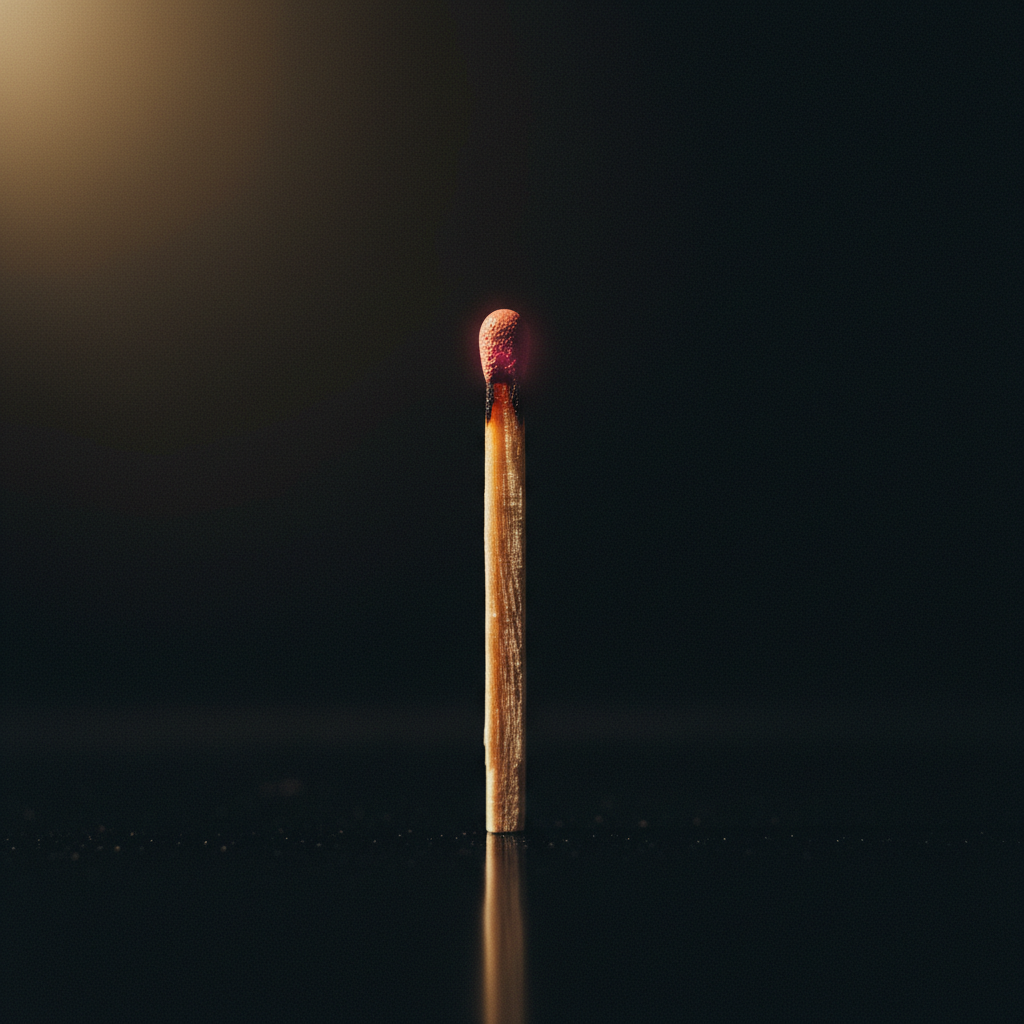
Many young people today don't even know what a matchstick is. With the widespread use of lighters and electronic ignition devices, matchsticks have long since disappeared from daily life, gradually becoming a kind of "antique." However, in the memories of people over forty, matchsticks still exist vividly, as an ordinary object of everyday life.
Literally speaking, a matchstick is simply the wooden part of a match. But compared to other "sticks" like walking sticks or canes, the matchstick seems extremely simple, unassuming, and even insignificant. It doesn't symbolize status, nor does it represent authority or reliance; its apparent purpose is merely a small wooden stick used for lighting a fire.
I once read about an incident in a very valuable book: someone, after using some medicine, gently nudged a tooth with a matchstick and actually knocked it out. At first glance, this seems incredible, but upon reflection, it's not a fabrication, but a real-life scenario that actually happened. At that time, matchsticks were not only used for lighting fires, but in certain situations, they were also temporarily used as tools.
The original purpose of a matchstick, of course, is to make fire. The earliest independent match factory in China was the "Qiaoming Match Factory," founded in Foshan, Guangdong in 1879. It wasn't until the 1920s and 1930s that matches gradually became popular among urban residents and in rural markets. So, in the thousands of years of history before that, and for more than a hundred years before the invention of matches, how did the Chinese people make fire?
In fact, science does not follow a single linear path of development, but rather branches out. Different eras have different scientific systems. Although ancient Chinese science differed in form from modern science, it was highly developed in many fields, sufficient to support a civilization that lasted for thousands of years. If we only understand other forms of civilization from the perspective of today's technology, such as alien spacecraft, we will inevitably find it difficult to comprehend. Similarly, future science may not necessarily be limited to today's scientific framework.
If we look at the matchstick from the perspective of "zhen(truth)," its truth lies in its lack of concealment or pretense: wood is wood, fire is fire, it ignites with a single strike, and is consumed with a single use. It reminds people that power doesn't necessarily have to be immense, and that truth itself has value. From the perspective of "shan(goodness)," the life of a matchstick is extremely simple: it illuminates the darkness, ignites the fire, and is then discarded. It never asks for anything in return, simply fulfilling its purpose. This is a kind of quiet goodness, one that is easily overlooked.
From the perspective of "ren(endurance)," the moment a matchstick is lit signifies its own demise, yet it brings warmth to others. What it "endures" is the brevity of its life, and what it accomplishes is the continuation of others' lives.
The mention of using a matchstick to pick one's teeth in the text is not complex in its meaning. However, some young people today truly don't understand or have never even seen a matchstick. Yet, the life experiences and cultural connotations it carries seem endless. Each time I read this, I gain a different understanding.
This article only discusses the surface meaning and my personal interpretation of the matchstick. As for its deeper connotations, one needs to read the original book to fully appreciate its profound meaning.